
Showing posts with label Internet. Show all posts
Showing posts with label Internet. Show all posts
Paying Up
A number of years ago, I did 2 1/2 years for what the state deemed a "non-dangerous, non-repetitive" crime. Upon my release, I was somewhat apprehensive as to how I might be accepted back into society, if at all. While in, I had heard horror stories. Many of the guards considered recidivism to be a foregone conclusion.
So I did a sort of experiment. Trying to get as varied a segment of the population as I could, I posted the details of my crime and punishment on a number of different internet forums (anonymously, of course), and asked people what they thought. The responses I got back where overwhelmingly negative. I expected that. I had, after all, broken the law.
What I didn't expect, was the venom associated with many of the responses. Up to, and including some disturbingly creative death threats. Those unwilling to take time out of their busy days to kill me themselves, asked that I take matters into my own hands, suggesting methods that I'm relatively certain are physically impossible.
At first, I was horrified. These were people who owned homes? Drove cars? Had jobs? Raised children? Yet these same people openly fantasized about killing me.
After the initial shock wore off, I was depressed for months afterward. If this was the response to my relatively mild trespass against society, what chance did anyone else have?
Back in the days of sailing ships, if a member of the crew broke the rules, the punishment was usually swift and severe. But it rarely resulted in death. An able-bodied seaman was a valuable commodity. Once his forty lashes were done with, he was once again a member of the crew, with the same rights and responsibilities, and the incident was not mentioned again. His debt was paid.
Not so now. We live in a society that increasingly considers even it's best and brightest as inherently expendable. We don't forget, we don't forgive, and no matter what your skills, or how well you live your life from then on, the debt is never paid.
Because of this, there are certain things that are now forever beyond my reach. I'll never have a job that will allow me to buy a home, get decent medical care, or save for retirement. If I'm lucky, and strong enough, I'll be allowed to work until I die. There are many who think this is just. But what if I'm not strong enough, and my health doesn't hold out? Some future taxpayer will have to foot the bill for things that I could be doing now.
Of course by then, some senator may come up with some politically correct final solution that the masses will find palatable. If so, I will go to my end gladly. As I would not want to live in such a world.
Who Deserves Rape?
A few days ago, a student 'preacher' at the U of A stood in front of the administration building, holding a sign that read 'you deserve rape'. The university's newspaper got some grief for reporting on the incident. There were those who felt that simply reporting on it lent legitimacy to his views. It did not.
Reprehensible though it was, his right to free speech is constitutionally protected.
When you think about it, it's actually a good thing. He's now out in the open, and those who have to interact with him are now forewarned, and forarmed.
Much more dangerous, and more common, I think, are those who believe these things, but never state those beliefs. They look just like decent people. Sometimes they attain power and responsibility. Sometimes they even end up making policy and law.
A lot of bad, immoral, and unjust decisions could be avoided, had we known where they were coming from beforehand.
Still, the students did the
right thing in responding with the same free speech the misogynist availed himself of.
Reprehensible though it was, his right to free speech is constitutionally protected.
When you think about it, it's actually a good thing. He's now out in the open, and those who have to interact with him are now forewarned, and forarmed.
Much more dangerous, and more common, I think, are those who believe these things, but never state those beliefs. They look just like decent people. Sometimes they attain power and responsibility. Sometimes they even end up making policy and law.
A lot of bad, immoral, and unjust decisions could be avoided, had we known where they were coming from beforehand.
Still, the students did the
right thing in responding with the same free speech the misogynist availed himself of.
Found Among the Ruins, and My Own Errant Thoughts
From Hank Fox:
The existence of the (GMO) technology doesn’t bother me in any extreme way. But that technology in the hands of nice corporations like Monsanto, in an oversight environment that includes a very friendly, very compliant pro-business government … that spooks me more than a little.
The downside of being emphatically yourself is that you can never slip easily into a group. You will always feel just a little bit ill-at-ease, a little bit off-balance, no matter where you are or who you’re with. For me, that price has almost always been acceptable. Still, I think I can understand the great numbers of us who make the other choice.
This is why I find the religious rights' passionate defense of marriage so amusing. A few excerpts from an article called: Marriage by Barbara G. Walker
Thomas Paine, in 1793, explains skepticism:
"The biggest failing of Libertarianism is the inability to distinguish liberty (the rights guaranteed by the state) from freedom (the practical ability to exercise those rights). Libertarianism ensures maximum liberty, but actual freedom is reserved only for the very rich."
-nigelTheBold, Abbot of the Hoppist Monks
The deception began, at least in the modern age, with Milton Friedman, who said "The free market system distributes the fruits of economic progress among all people...He moves fastest who moves alone."
This unflagging adherence to free-enterprise individualism is consistent with Social Darwinism , the belief that survival of the fittest (richest) will somehow benefit society, and that the millions of people suffering from financial malfeasance are simply lacking the motivation to help themselves. Social Darwinism is a feel-good delusion for those at the top. Or, as described by John Kenneth Galbraith, a continuing "search for a superior moral justification for selfishness."
A tenet of progressivism is that a strong society will create opportunities for a greater number of people, thereby leading to more instances of individual success. This is the common sense attitude suppressed by conservatives for over 30 years.
There is a very good reason evolution invented death. The cycle of life and death ensures that a species adapts much better to changing circumstances. Imagine a society where everybody is immortal. It quite inevitably culminates in an ultra-conservative nightmare, where “everything is like it was forever”. Imagine a society where the industry tycoons of the 19th century still own the majority of money and influence.
A static society must break down sooner or later, one of the best examples for this is the late Soviet Union, where nothing new happened and which was completely dominated by old men who still evaluated everything in terms of an economy based on heavy industry. And when society breaks down (what it does regularly in human history, this is inevitable), most people will then lose the access to this life-prolonging technology.
I am glad that death exists, and when my time arrives, I will go, to make place for the young generation. They deserve their chance.
The existence of the (GMO) technology doesn’t bother me in any extreme way. But that technology in the hands of nice corporations like Monsanto, in an oversight environment that includes a very friendly, very compliant pro-business government … that spooks me more than a little.
The downside of being emphatically yourself is that you can never slip easily into a group. You will always feel just a little bit ill-at-ease, a little bit off-balance, no matter where you are or who you’re with. For me, that price has almost always been acceptable. Still, I think I can understand the great numbers of us who make the other choice.
This is why I find the religious rights' passionate defense of marriage so amusing. A few excerpts from an article called: Marriage by Barbara G. Walker
The word marriage came from the Latin maritare, union under the
auspices of the Goddess Aphrodite-Mari. Because the Goddess’s
patronage was constantly invoked in every aspect of marriage, Christian fathers were opposed to the institution. Origen declared, “Matrimony is impure and unholy, a means of sexual passion.” St. Jerome said the primary purpose of a man of God was “to cut down with an ax of Virginity the wood of Marriage”.(1) St. Ambrose said marriage was a crime against god, because it changed the state of virginity that God gave every man and woman at birth.(2)
St. Augustine flatly stated that marriage is a sin and St. Paul damned Marriage with faint praise, remarking that to marry was only better than to burn ( 1 cor. 7:9).
Saturninus said God made only two kinds of people, good men and evil women. Marriage perpetuated the deviltry of women, who dominated men through the magic of sex(8). Centuries later, St. Bernard still proclaimed that it was easier of a man to bring back the dead to life than to live with a woman without endangering ones soul.(9)
Priests abandoned the churches’ rule of celibacy and began to take wives during the 5th and 6th centuries. This continued to the 11th century, when papal decretals commanded married clergymen to turn their wives out of their homes and sell their children as slaves. (5) The church displayed remarkable reluctance to deal with the matter of marriage at all. During the Middle Ages there was no ecclesiastical definition of a valid marriage nor of any contract to validate one.
Churchmen seemed to have no ideas at all on the subject(6) The earliest form of Christian marriage was a simple blessing of the newly wedded, “in facie ecclesiae” –outside the churches closed doors– to keep the pollution of lust out of God’s house. This blessing was a technical violation of canon law, but it became popular and gradually won status.(7).
There was no sacrament of marriage until the 16th century (3). Catholic scholars say the wedding ceremony was “imposed on” a reluctant church, and “nothing is more remarkable that the tardiness with which liturgical forms for the marriage ceremony were evolved.” It is perhaps not remarkable to find that these liturgical forms were not evolved by the church at all, but borrowed from pagan common law (4).
1-William Fielding, Customs of Courtship and Marriage, 82, 114
2-Robert Briffault, The Mothers, Vol 3, 373
3-William Fielding, Customs of Courtship and Marriage, 233
4-Robert Briffault, The Mothers, Vol 3, 248-249
5-Jacobus de. Voragine, The Golden Legend, 90-91
6-Ronald Pearsall, The Worm in the Bud , 162-63
7-Encyclopedia Britannica, “Marriage”
8-Vern Bullough,The Subordinate Sex, 103, 112
9-Joseph Cambell, Myths to Live By, 95
Thomas Paine, in 1793, explains skepticism:
"Every national church or religion has established itself by pretending some special mission from God, communicated to certain individuals. The Jews have their Moses; the Christians their Jesus Christ, their apostles and saints; and the Turks their Mahomet; as if the way to God was not open to every man alike.
Each of those churches shows certain books, which they call revelation, or the Word of God. The Jews say that their Word of God was given by God to Moses face to face; the Christians say, that their Word of God came by divine inspiration; and the Turks say, that their Word of God (the Koran) was brought by an angel from heaven. Each of those churches accuses the other of unbelief; and, for my own part, I disbelieve them all.
As it is necessary to affix right ideas to words, I will, before I proceed further into the subject, offer some observations on the word ‘revelation.’ Revelation when applied to religion, means something communicated immediately from God to man.
No one will deny or dispute the power of the Almighty to make such a communication if he pleases. But admitting, for the sake of a case, that something has been revealed to a certain person, and not revealed to any other person, it is revelation to that person only. When he tells it to a second person, a second to a third, a third to a fourth, and so on, it ceases to be a revelation to all those persons. It is revelation to the first person only, and hearsay to every other, and, consequently, they are not obliged to believe it.
It is a contradiction in terms and ideas to call anything a revelation that comes to us at second hand, either verbally or in writing. Revelation is necessarily limited to the first communication. After this, it is only an account of something which that person says was a revelation made to him; and though he may find himself obliged to believe it, it cannot be incumbent on me to believe it in the same manner, for it was not a revelation made to me, and I have only his word for it that it was made to him.
When Moses told the children of Israel that he received the two tables of the commandments from the hand of God, they were not obliged to believe him, because they had no other authority for it than his telling them so; and I have no other authority for it than some historian telling me so, the commandments carrying no internal evidence of divinity with them. They contain some good moral precepts such as any man qualified to be a lawgiver or a legislator could produce himself, without having recourse to supernatural intervention. [NOTE: It is, however, necessary to except the declamation which says that God 'visits the sins of the fathers upon the children'. This is contrary to every principle of moral justice.—Author.]
When I am told that the Koran was written in Heaven, and brought to Mahomet by an angel, the account comes to near the same kind of hearsay evidence and second hand authority as the former. I did not see the angel myself, and therefore I have a right not to believe it.
When also I am told that a woman, called the Virgin Mary, said, or gave out, that she was with child without any cohabitation with a man, and that her betrothed husband, Joseph, said that an angel told him so, I have a right to believe them or not: such a circumstance required a much stronger evidence than their bare word for it: but we have not even this; for neither Joseph nor Mary wrote any such matter themselves. It is only reported by others that they said so. It is hearsay upon hearsay, and I do not chose to rest my belief upon such evidence."
"The biggest failing of Libertarianism is the inability to distinguish liberty (the rights guaranteed by the state) from freedom (the practical ability to exercise those rights). Libertarianism ensures maximum liberty, but actual freedom is reserved only for the very rich."
-nigelTheBold, Abbot of the Hoppist Monks
The deception began, at least in the modern age, with Milton Friedman, who said "The free market system distributes the fruits of economic progress among all people...He moves fastest who moves alone."
This unflagging adherence to free-enterprise individualism is consistent with Social Darwinism , the belief that survival of the fittest (richest) will somehow benefit society, and that the millions of people suffering from financial malfeasance are simply lacking the motivation to help themselves. Social Darwinism is a feel-good delusion for those at the top. Or, as described by John Kenneth Galbraith, a continuing "search for a superior moral justification for selfishness."
A tenet of progressivism is that a strong society will create opportunities for a greater number of people, thereby leading to more instances of individual success. This is the common sense attitude suppressed by conservatives for over 30 years.
There is a very good reason evolution invented death. The cycle of life and death ensures that a species adapts much better to changing circumstances. Imagine a society where everybody is immortal. It quite inevitably culminates in an ultra-conservative nightmare, where “everything is like it was forever”. Imagine a society where the industry tycoons of the 19th century still own the majority of money and influence.
A static society must break down sooner or later, one of the best examples for this is the late Soviet Union, where nothing new happened and which was completely dominated by old men who still evaluated everything in terms of an economy based on heavy industry. And when society breaks down (what it does regularly in human history, this is inevitable), most people will then lose the access to this life-prolonging technology.
I am glad that death exists, and when my time arrives, I will go, to make place for the young generation. They deserve their chance.
Just So You Know Where My Head's At
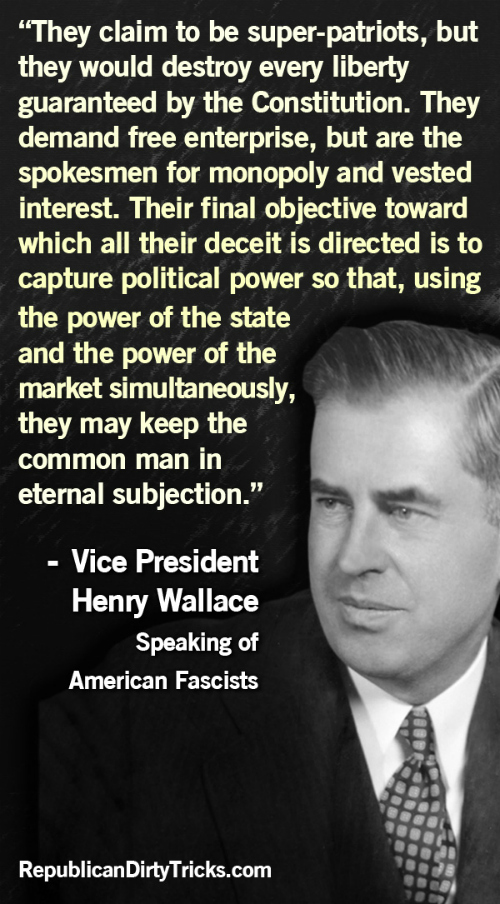
Ah the good old days, back when there was actually such a thing as a lucid Republican. Granted, I disagreed with him on many issues. But that's the point. He was able to prioritize and discern real issues, rather than the stupidity and minutia that today's Republicans focus on.

This speaks for itself.

Pretty much sums it up.

Sound familiar?

Admittedly, I'm not as chipper as I once was....


This speaks for itself.

Pretty much sums it up.

Sound familiar?
Admittedly, I'm not as chipper as I once was....

Nothing changes
Among all the images floating around the internet, I came across this.
 Does the rhetoric sound familiar? Trade Kennedy's face for Obama's, and it could have been written today.
They call themselves the Tea Party, but they've always been around. The intolerant, ultra-religious, racist, mouth-breathing fools may always be with us.
We fail to impart the mistakes we've made to our children, so the cycle repeats. Or, worse, we feed them the poison that was fed to us, and the ignorance continues.

They call themselves the Tea Party, but they've always been around. The intolerant, ultra-religious, racist, mouth-breathing fools may always be with us.
We fail to impart the mistakes we've made to our children, so the cycle repeats. Or, worse, we feed them the poison that was fed to us, and the ignorance continues.
American Media
Ok, so I'm a boomer (although just barely, thank you). I remember Walter Cronkite, David Brinkley, John Chancellor, and others growing up. They just reported the news. They did it without spin, innuendo, and to the best of their ability, truthfully.
I'm not usually prone to nostalgia, but like so many other things, the decline of American journalism was too subtle for me to notice. I was too busy with the day to day business of living to take notice. I bear some of the blame for neglecting my duty as a citizen, and assuming that simply voting was enough. It's my country - my government, and I should have more informed and involved. I don't know if I could have made a difference, but at least I'd have the comfort of knowing I tried.
So here we are.
Secretary of State Hillary Clinton spoke before the Senate Foreign Relations Committee last Wednesday. While doing so, she made some long overdue comparisons of the American media to Al-Jazeera. She said,
I figured it out about a year ago. I'd had it with the right-wing lies of Fox, the left-wing cheerleading of MSNBC, and the fluff of CNN. The only real news I was getting was from the Daily Show. As much as I like Jon Stewart, it wasn't enough.
My first stop was NPR, but their perspective was inherently American. The BBC was the next step. It's been the standard for exceptional journalism for years, though I often had to wade through a lot that I found less than relevant. Then I found Al-Jazeera. It was an eye-opener. I was outraged at some things. They would have people on that were blatantly anti-American. In some instances I could understand why they felt the way they did. Our foreign policy over the last half-century has been less than honorable. In other instances, their guests were simply the mirror image of the extreme religious right in this country. Opposing views, but the same hate.
Then I took notice, not so much of the content, but how it was presented. Whether pro, anti, or neutral, the reporting was just that, backed up by empirical data and sources.
It was then I realized how far we'd fallen. The American media isn't in the business of providing factual information to people. It's in business to sell the attention spans of those watching to other corporations. I'd like to think it's more complex than that, but it really is that simple.
No ethics, no integrity. Just money.
Somewhere along the way, big business decided that every human thought, every human endeavor, was theirs to profit from. No regard for privacy, or ethics. No thought as to what is morally or socially acceptable. It's whatever one can get away with. If it happens to be against the law, well, that's what lobbyists and campaign contributions are for. Perhaps it's always been that way. It's just more pronounced now.
This is America with Republicorp running things.
No more middle class. Just the stockholders, and those that serve them.
I'm not usually prone to nostalgia, but like so many other things, the decline of American journalism was too subtle for me to notice. I was too busy with the day to day business of living to take notice. I bear some of the blame for neglecting my duty as a citizen, and assuming that simply voting was enough. It's my country - my government, and I should have more informed and involved. I don't know if I could have made a difference, but at least I'd have the comfort of knowing I tried.
So here we are.
Secretary of State Hillary Clinton spoke before the Senate Foreign Relations Committee last Wednesday. While doing so, she made some long overdue comparisons of the American media to Al-Jazeera. She said,
“In fact viewership of Al Jazeera is going up in the United States because it’s real news,” Clinton said. “You may not agree with it, but you feel like you’re getting real news around the clock instead of a million commercials and, you know, arguments between talking heads and the kind of stuff that we do on our news which, you know, is not particularly informative to us, let alone foreigners.”Perhaps she was following the lead of Homeland Security Assistant Secretary Juliette Kayyem, who urged cable providers to carry al Jazeera in her recent oped, “Let us see Al-Jazeera”.
I figured it out about a year ago. I'd had it with the right-wing lies of Fox, the left-wing cheerleading of MSNBC, and the fluff of CNN. The only real news I was getting was from the Daily Show. As much as I like Jon Stewart, it wasn't enough.
My first stop was NPR, but their perspective was inherently American. The BBC was the next step. It's been the standard for exceptional journalism for years, though I often had to wade through a lot that I found less than relevant. Then I found Al-Jazeera. It was an eye-opener. I was outraged at some things. They would have people on that were blatantly anti-American. In some instances I could understand why they felt the way they did. Our foreign policy over the last half-century has been less than honorable. In other instances, their guests were simply the mirror image of the extreme religious right in this country. Opposing views, but the same hate.
Then I took notice, not so much of the content, but how it was presented. Whether pro, anti, or neutral, the reporting was just that, backed up by empirical data and sources.
It was then I realized how far we'd fallen. The American media isn't in the business of providing factual information to people. It's in business to sell the attention spans of those watching to other corporations. I'd like to think it's more complex than that, but it really is that simple.
No ethics, no integrity. Just money.
Somewhere along the way, big business decided that every human thought, every human endeavor, was theirs to profit from. No regard for privacy, or ethics. No thought as to what is morally or socially acceptable. It's whatever one can get away with. If it happens to be against the law, well, that's what lobbyists and campaign contributions are for. Perhaps it's always been that way. It's just more pronounced now.
This is America with Republicorp running things.
No more middle class. Just the stockholders, and those that serve them.
Subscribe to:
Posts (Atom)