
Showing posts with label history. Show all posts
Showing posts with label history. Show all posts
Paying Up
A number of years ago, I did 2 1/2 years for what the state deemed a "non-dangerous, non-repetitive" crime. Upon my release, I was somewhat apprehensive as to how I might be accepted back into society, if at all. While in, I had heard horror stories. Many of the guards considered recidivism to be a foregone conclusion.
So I did a sort of experiment. Trying to get as varied a segment of the population as I could, I posted the details of my crime and punishment on a number of different internet forums (anonymously, of course), and asked people what they thought. The responses I got back where overwhelmingly negative. I expected that. I had, after all, broken the law.
What I didn't expect, was the venom associated with many of the responses. Up to, and including some disturbingly creative death threats. Those unwilling to take time out of their busy days to kill me themselves, asked that I take matters into my own hands, suggesting methods that I'm relatively certain are physically impossible.
At first, I was horrified. These were people who owned homes? Drove cars? Had jobs? Raised children? Yet these same people openly fantasized about killing me.
After the initial shock wore off, I was depressed for months afterward. If this was the response to my relatively mild trespass against society, what chance did anyone else have?
Back in the days of sailing ships, if a member of the crew broke the rules, the punishment was usually swift and severe. But it rarely resulted in death. An able-bodied seaman was a valuable commodity. Once his forty lashes were done with, he was once again a member of the crew, with the same rights and responsibilities, and the incident was not mentioned again. His debt was paid.
Not so now. We live in a society that increasingly considers even it's best and brightest as inherently expendable. We don't forget, we don't forgive, and no matter what your skills, or how well you live your life from then on, the debt is never paid.
Because of this, there are certain things that are now forever beyond my reach. I'll never have a job that will allow me to buy a home, get decent medical care, or save for retirement. If I'm lucky, and strong enough, I'll be allowed to work until I die. There are many who think this is just. But what if I'm not strong enough, and my health doesn't hold out? Some future taxpayer will have to foot the bill for things that I could be doing now.
Of course by then, some senator may come up with some politically correct final solution that the masses will find palatable. If so, I will go to my end gladly. As I would not want to live in such a world.
Not Intelligent Design
Tim Minchin said it best,
Let's assume for a moment that there is an intelligence that created this universe (and all the others). It would have to come from outside the universe. So alien as to be incomprehensible (you can't think 11 dimensional thoughts with a three dimensional brain, after all). No more capable of having a personal relationship with us, than we are of having a personal relationship with any one of the millions of nutrinos that are passing through our collective thumbnails at this very moment.
I think the only thing we could possibly have in common, is our imperfection. Nothing is perfect, nor should it be. Since, by definition, it's impossible for a perfect being to create anything imperfect, our hypothetical creator must be subject to error. Indeed, a perfect universe could not exist because the universe exists by virtue of imperfection.
An event. A broken symmetry. A point of reference.
While perfection, and, to some extent, infinity, can be imagined, they cannot exist because the physical laws of this universe prevent it. Were it otherwise, perfection would be a static, sterile thing. Probably the closest thing to absolute nothingness I can imagine. You see the paradox.
Much more likely, I think, is that this universe, and everything in it, is a very tiny part, perhaps even an unintended side effect, of some grander creation.
All of that being said, the end result ends up being the same for us. No heaven, no hell, no grey-bearded old man judging whether we have sinned by wearing two different types of fabric, or planting two different types of crops, or marrying the wrong person, or eating the wrong food, or working on the wrong day, or any of the myriad of silly rules imposed by a primitive belief system that does nothing to explain us or our place in the universe.
The question ends up being meaningless because the result of his existence is the same is that of his non-existence.
"Isn't this enough? Just...this? How does the natural universe so fail to hold our imaginations, that we have to diminish it with man-made myths and monsters?"
Let's assume for a moment that there is an intelligence that created this universe (and all the others). It would have to come from outside the universe. So alien as to be incomprehensible (you can't think 11 dimensional thoughts with a three dimensional brain, after all). No more capable of having a personal relationship with us, than we are of having a personal relationship with any one of the millions of nutrinos that are passing through our collective thumbnails at this very moment.
I think the only thing we could possibly have in common, is our imperfection. Nothing is perfect, nor should it be. Since, by definition, it's impossible for a perfect being to create anything imperfect, our hypothetical creator must be subject to error. Indeed, a perfect universe could not exist because the universe exists by virtue of imperfection.
An event. A broken symmetry. A point of reference.
While perfection, and, to some extent, infinity, can be imagined, they cannot exist because the physical laws of this universe prevent it. Were it otherwise, perfection would be a static, sterile thing. Probably the closest thing to absolute nothingness I can imagine. You see the paradox.
Much more likely, I think, is that this universe, and everything in it, is a very tiny part, perhaps even an unintended side effect, of some grander creation.
All of that being said, the end result ends up being the same for us. No heaven, no hell, no grey-bearded old man judging whether we have sinned by wearing two different types of fabric, or planting two different types of crops, or marrying the wrong person, or eating the wrong food, or working on the wrong day, or any of the myriad of silly rules imposed by a primitive belief system that does nothing to explain us or our place in the universe.
The question ends up being meaningless because the result of his existence is the same is that of his non-existence.
Who Deserves Rape?
A few days ago, a student 'preacher' at the U of A stood in front of the administration building, holding a sign that read 'you deserve rape'. The university's newspaper got some grief for reporting on the incident. There were those who felt that simply reporting on it lent legitimacy to his views. It did not.
Reprehensible though it was, his right to free speech is constitutionally protected.
When you think about it, it's actually a good thing. He's now out in the open, and those who have to interact with him are now forewarned, and forarmed.
Much more dangerous, and more common, I think, are those who believe these things, but never state those beliefs. They look just like decent people. Sometimes they attain power and responsibility. Sometimes they even end up making policy and law.
A lot of bad, immoral, and unjust decisions could be avoided, had we known where they were coming from beforehand.
Still, the students did the
right thing in responding with the same free speech the misogynist availed himself of.
Reprehensible though it was, his right to free speech is constitutionally protected.
When you think about it, it's actually a good thing. He's now out in the open, and those who have to interact with him are now forewarned, and forarmed.
Much more dangerous, and more common, I think, are those who believe these things, but never state those beliefs. They look just like decent people. Sometimes they attain power and responsibility. Sometimes they even end up making policy and law.
A lot of bad, immoral, and unjust decisions could be avoided, had we known where they were coming from beforehand.
Still, the students did the
right thing in responding with the same free speech the misogynist availed himself of.
Found Among the Ruins, and My Own Errant Thoughts
From Hank Fox:
The existence of the (GMO) technology doesn’t bother me in any extreme way. But that technology in the hands of nice corporations like Monsanto, in an oversight environment that includes a very friendly, very compliant pro-business government … that spooks me more than a little.
The downside of being emphatically yourself is that you can never slip easily into a group. You will always feel just a little bit ill-at-ease, a little bit off-balance, no matter where you are or who you’re with. For me, that price has almost always been acceptable. Still, I think I can understand the great numbers of us who make the other choice.
This is why I find the religious rights' passionate defense of marriage so amusing. A few excerpts from an article called: Marriage by Barbara G. Walker
Thomas Paine, in 1793, explains skepticism:
"The biggest failing of Libertarianism is the inability to distinguish liberty (the rights guaranteed by the state) from freedom (the practical ability to exercise those rights). Libertarianism ensures maximum liberty, but actual freedom is reserved only for the very rich."
-nigelTheBold, Abbot of the Hoppist Monks
The deception began, at least in the modern age, with Milton Friedman, who said "The free market system distributes the fruits of economic progress among all people...He moves fastest who moves alone."
This unflagging adherence to free-enterprise individualism is consistent with Social Darwinism , the belief that survival of the fittest (richest) will somehow benefit society, and that the millions of people suffering from financial malfeasance are simply lacking the motivation to help themselves. Social Darwinism is a feel-good delusion for those at the top. Or, as described by John Kenneth Galbraith, a continuing "search for a superior moral justification for selfishness."
A tenet of progressivism is that a strong society will create opportunities for a greater number of people, thereby leading to more instances of individual success. This is the common sense attitude suppressed by conservatives for over 30 years.
There is a very good reason evolution invented death. The cycle of life and death ensures that a species adapts much better to changing circumstances. Imagine a society where everybody is immortal. It quite inevitably culminates in an ultra-conservative nightmare, where “everything is like it was forever”. Imagine a society where the industry tycoons of the 19th century still own the majority of money and influence.
A static society must break down sooner or later, one of the best examples for this is the late Soviet Union, where nothing new happened and which was completely dominated by old men who still evaluated everything in terms of an economy based on heavy industry. And when society breaks down (what it does regularly in human history, this is inevitable), most people will then lose the access to this life-prolonging technology.
I am glad that death exists, and when my time arrives, I will go, to make place for the young generation. They deserve their chance.
The existence of the (GMO) technology doesn’t bother me in any extreme way. But that technology in the hands of nice corporations like Monsanto, in an oversight environment that includes a very friendly, very compliant pro-business government … that spooks me more than a little.
The downside of being emphatically yourself is that you can never slip easily into a group. You will always feel just a little bit ill-at-ease, a little bit off-balance, no matter where you are or who you’re with. For me, that price has almost always been acceptable. Still, I think I can understand the great numbers of us who make the other choice.
This is why I find the religious rights' passionate defense of marriage so amusing. A few excerpts from an article called: Marriage by Barbara G. Walker
The word marriage came from the Latin maritare, union under the
auspices of the Goddess Aphrodite-Mari. Because the Goddess’s
patronage was constantly invoked in every aspect of marriage, Christian fathers were opposed to the institution. Origen declared, “Matrimony is impure and unholy, a means of sexual passion.” St. Jerome said the primary purpose of a man of God was “to cut down with an ax of Virginity the wood of Marriage”.(1) St. Ambrose said marriage was a crime against god, because it changed the state of virginity that God gave every man and woman at birth.(2)
St. Augustine flatly stated that marriage is a sin and St. Paul damned Marriage with faint praise, remarking that to marry was only better than to burn ( 1 cor. 7:9).
Saturninus said God made only two kinds of people, good men and evil women. Marriage perpetuated the deviltry of women, who dominated men through the magic of sex(8). Centuries later, St. Bernard still proclaimed that it was easier of a man to bring back the dead to life than to live with a woman without endangering ones soul.(9)
Priests abandoned the churches’ rule of celibacy and began to take wives during the 5th and 6th centuries. This continued to the 11th century, when papal decretals commanded married clergymen to turn their wives out of their homes and sell their children as slaves. (5) The church displayed remarkable reluctance to deal with the matter of marriage at all. During the Middle Ages there was no ecclesiastical definition of a valid marriage nor of any contract to validate one.
Churchmen seemed to have no ideas at all on the subject(6) The earliest form of Christian marriage was a simple blessing of the newly wedded, “in facie ecclesiae” –outside the churches closed doors– to keep the pollution of lust out of God’s house. This blessing was a technical violation of canon law, but it became popular and gradually won status.(7).
There was no sacrament of marriage until the 16th century (3). Catholic scholars say the wedding ceremony was “imposed on” a reluctant church, and “nothing is more remarkable that the tardiness with which liturgical forms for the marriage ceremony were evolved.” It is perhaps not remarkable to find that these liturgical forms were not evolved by the church at all, but borrowed from pagan common law (4).
1-William Fielding, Customs of Courtship and Marriage, 82, 114
2-Robert Briffault, The Mothers, Vol 3, 373
3-William Fielding, Customs of Courtship and Marriage, 233
4-Robert Briffault, The Mothers, Vol 3, 248-249
5-Jacobus de. Voragine, The Golden Legend, 90-91
6-Ronald Pearsall, The Worm in the Bud , 162-63
7-Encyclopedia Britannica, “Marriage”
8-Vern Bullough,The Subordinate Sex, 103, 112
9-Joseph Cambell, Myths to Live By, 95
Thomas Paine, in 1793, explains skepticism:
"Every national church or religion has established itself by pretending some special mission from God, communicated to certain individuals. The Jews have their Moses; the Christians their Jesus Christ, their apostles and saints; and the Turks their Mahomet; as if the way to God was not open to every man alike.
Each of those churches shows certain books, which they call revelation, or the Word of God. The Jews say that their Word of God was given by God to Moses face to face; the Christians say, that their Word of God came by divine inspiration; and the Turks say, that their Word of God (the Koran) was brought by an angel from heaven. Each of those churches accuses the other of unbelief; and, for my own part, I disbelieve them all.
As it is necessary to affix right ideas to words, I will, before I proceed further into the subject, offer some observations on the word ‘revelation.’ Revelation when applied to religion, means something communicated immediately from God to man.
No one will deny or dispute the power of the Almighty to make such a communication if he pleases. But admitting, for the sake of a case, that something has been revealed to a certain person, and not revealed to any other person, it is revelation to that person only. When he tells it to a second person, a second to a third, a third to a fourth, and so on, it ceases to be a revelation to all those persons. It is revelation to the first person only, and hearsay to every other, and, consequently, they are not obliged to believe it.
It is a contradiction in terms and ideas to call anything a revelation that comes to us at second hand, either verbally or in writing. Revelation is necessarily limited to the first communication. After this, it is only an account of something which that person says was a revelation made to him; and though he may find himself obliged to believe it, it cannot be incumbent on me to believe it in the same manner, for it was not a revelation made to me, and I have only his word for it that it was made to him.
When Moses told the children of Israel that he received the two tables of the commandments from the hand of God, they were not obliged to believe him, because they had no other authority for it than his telling them so; and I have no other authority for it than some historian telling me so, the commandments carrying no internal evidence of divinity with them. They contain some good moral precepts such as any man qualified to be a lawgiver or a legislator could produce himself, without having recourse to supernatural intervention. [NOTE: It is, however, necessary to except the declamation which says that God 'visits the sins of the fathers upon the children'. This is contrary to every principle of moral justice.—Author.]
When I am told that the Koran was written in Heaven, and brought to Mahomet by an angel, the account comes to near the same kind of hearsay evidence and second hand authority as the former. I did not see the angel myself, and therefore I have a right not to believe it.
When also I am told that a woman, called the Virgin Mary, said, or gave out, that she was with child without any cohabitation with a man, and that her betrothed husband, Joseph, said that an angel told him so, I have a right to believe them or not: such a circumstance required a much stronger evidence than their bare word for it: but we have not even this; for neither Joseph nor Mary wrote any such matter themselves. It is only reported by others that they said so. It is hearsay upon hearsay, and I do not chose to rest my belief upon such evidence."
"The biggest failing of Libertarianism is the inability to distinguish liberty (the rights guaranteed by the state) from freedom (the practical ability to exercise those rights). Libertarianism ensures maximum liberty, but actual freedom is reserved only for the very rich."
-nigelTheBold, Abbot of the Hoppist Monks
The deception began, at least in the modern age, with Milton Friedman, who said "The free market system distributes the fruits of economic progress among all people...He moves fastest who moves alone."
This unflagging adherence to free-enterprise individualism is consistent with Social Darwinism , the belief that survival of the fittest (richest) will somehow benefit society, and that the millions of people suffering from financial malfeasance are simply lacking the motivation to help themselves. Social Darwinism is a feel-good delusion for those at the top. Or, as described by John Kenneth Galbraith, a continuing "search for a superior moral justification for selfishness."
A tenet of progressivism is that a strong society will create opportunities for a greater number of people, thereby leading to more instances of individual success. This is the common sense attitude suppressed by conservatives for over 30 years.
There is a very good reason evolution invented death. The cycle of life and death ensures that a species adapts much better to changing circumstances. Imagine a society where everybody is immortal. It quite inevitably culminates in an ultra-conservative nightmare, where “everything is like it was forever”. Imagine a society where the industry tycoons of the 19th century still own the majority of money and influence.
A static society must break down sooner or later, one of the best examples for this is the late Soviet Union, where nothing new happened and which was completely dominated by old men who still evaluated everything in terms of an economy based on heavy industry. And when society breaks down (what it does regularly in human history, this is inevitable), most people will then lose the access to this life-prolonging technology.
I am glad that death exists, and when my time arrives, I will go, to make place for the young generation. They deserve their chance.
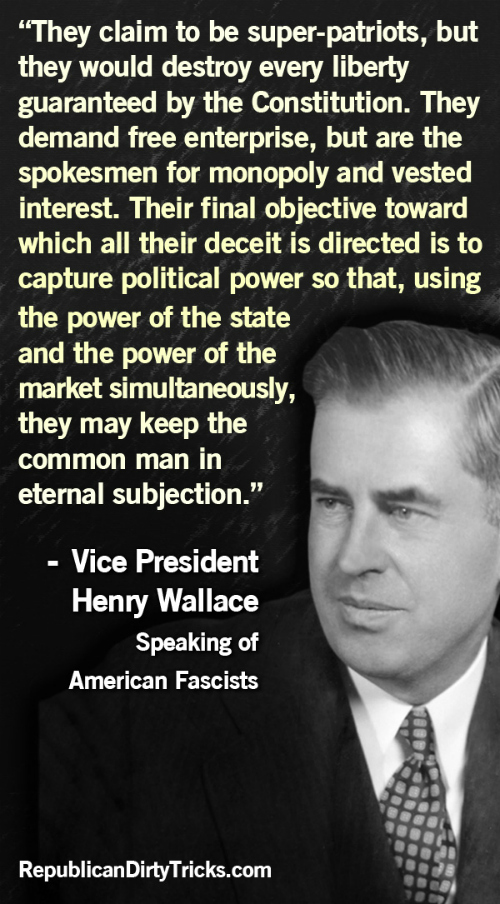
Just So You Know Where My Head's At
Ah the good old days, back when there was actually such a thing as a lucid Republican. Granted, I disagreed with him on many issues. But that's the point. He was able to prioritize and discern real issues, rather than the stupidity and minutia that today's Republicans focus on.

This speaks for itself.

Pretty much sums it up.

Sound familiar?

Admittedly, I'm not as chipper as I once was....


This speaks for itself.

Pretty much sums it up.

Sound familiar?
Admittedly, I'm not as chipper as I once was....

Sympathy
I haven't posted in a while. My brother passed two months ago today. It was sudden and unexpected. One of those cancers that show little in the way of symptoms until it's too late.
I'm not exactly what one would call emotionally demonstrative, unless you count being perpetually glib an emotion. (Yeah, I know. Yada yada defense mechanism...I'm workin' on it, alright?). So I was caught off guard as far as how much his loss affected everything I was doing. Especially writing. I usually write a blog post down on paper, then go back and read it a day or so later. At that point, I usually think, "What crap", and try again.
You're welcome.
My brother and I weren't close growing up. He was 15 years older, and out on his own before I was really aware of his presence. As a teenager, I spent a couple of summers with him and his family. I had a lot of hair, and an equal amount of angst. But he was patient with me, and I was lucid enough between bong hits for some of it to take. He would occasionally get the look on his face that hard to describe. It was his way of calling bullshit when I did or said something stupid. Whatever it was, it worked.
After I became an adult, my brother and I found that we had two diametrically opposing political viewpoints. This made for some interesting Thanksgivings, and a couple of decades' worth of spirited emails.
For me, it began when Reagan was elected. I knew it was bad. Really bad. I knew that the consequences would be far-reaching. Being able to say, "I told you so" isn't as fun as I thought it would be.
I suspect now that, much of the time, my brother was playing devil's advocate in order to get me to think logically, and back up my opinions. If so, I owe him a debt of gratitude.
But what I've learned, is that logic and reason must be tempered with empathy and compassion. Otherwise, we tend to end up doing what is expedient, rather than what is right.
Part of my liberalism, and my atheism for that matter, is the belief that most people are good, decent, hard-working folks just trying to do the best they can. Sometimes this is little more than a carefully cultivated delusion. But it's a necessary one, I think. When I'm wrong, it is often spectacularly so. But the times I'm right more than make up for it. If I'm to err, I prefer it to be on the positive side. The problem is, that it requires a strength which I don't always posses. It's at these times, I tend to go into a sort of hibernation until it passes.
Otherwise, I run the risk of seeing, in my mind's eye, that look on my brother's face.
I'm not exactly what one would call emotionally demonstrative, unless you count being perpetually glib an emotion. (Yeah, I know. Yada yada defense mechanism...I'm workin' on it, alright?). So I was caught off guard as far as how much his loss affected everything I was doing. Especially writing. I usually write a blog post down on paper, then go back and read it a day or so later. At that point, I usually think, "What crap", and try again.
You're welcome.
My brother and I weren't close growing up. He was 15 years older, and out on his own before I was really aware of his presence. As a teenager, I spent a couple of summers with him and his family. I had a lot of hair, and an equal amount of angst. But he was patient with me, and I was lucid enough between bong hits for some of it to take. He would occasionally get the look on his face that hard to describe. It was his way of calling bullshit when I did or said something stupid. Whatever it was, it worked.
After I became an adult, my brother and I found that we had two diametrically opposing political viewpoints. This made for some interesting Thanksgivings, and a couple of decades' worth of spirited emails.
For me, it began when Reagan was elected. I knew it was bad. Really bad. I knew that the consequences would be far-reaching. Being able to say, "I told you so" isn't as fun as I thought it would be.
I suspect now that, much of the time, my brother was playing devil's advocate in order to get me to think logically, and back up my opinions. If so, I owe him a debt of gratitude.
But what I've learned, is that logic and reason must be tempered with empathy and compassion. Otherwise, we tend to end up doing what is expedient, rather than what is right.
Part of my liberalism, and my atheism for that matter, is the belief that most people are good, decent, hard-working folks just trying to do the best they can. Sometimes this is little more than a carefully cultivated delusion. But it's a necessary one, I think. When I'm wrong, it is often spectacularly so. But the times I'm right more than make up for it. If I'm to err, I prefer it to be on the positive side. The problem is, that it requires a strength which I don't always posses. It's at these times, I tend to go into a sort of hibernation until it passes.
Otherwise, I run the risk of seeing, in my mind's eye, that look on my brother's face.
Life Eternal
I'm an atheist. I don't believe in an afterlife. If you think I'm happy about that, you're wrong. The average 78 year lifespan of an American male is entirely too short for my liking.
On the other hand, if one were to think it through, eternal life would be a fate worse than death. After a relatively short time (compared to infinity), you would have thought your last original thought. No more sense of wonder, your every action done by rote. Assuming finite memory, you would eventually forget how you came to be, everyone you ever loved, everything you once thought important. Eternal life as a zombie? Thank you, no.
I'm sure there's a happy medium in there somewhere. We may even achieve it someday. How long is long enough to reach one's full potential? I'm sure the answer is as varied as every member of humanity.
Early in our relationship, I tried to explain to my wife (a believer) how I came to be an atheist. As I did so, I began to see a sort of fear, even panic behind her eyes. For days afterward, she was depressed. I felt horrible, and I've never brought up the subject again. I vowed then, that if a person's belief did them no harm, and gave them comfort, I'd leave them their illusion. In the end, they'll never even know they were wrong.
As for me, I've taken Carl Sagan's advice: "Better a hard truth, than a comforting fable."
Unfortunately, believers like my wife, people whose moral compass isn't swayed by people like Pat Robertson, and other prophets of hate too numerous to mention, are becoming an endangered species.
There are those, so conditioned by their beliefs, that they would cheerfully commit the most horrible of atrocities if they believed it to be the will of their god. For them, the wage of sin is death. Of course, their definition of sin is often a matter of convenience.
These arbitrary definitions are a common occurrence in the Middle East, and could easily be here, if Dominionists ever succeed in their efforts of doing away with the secular nature of our government.
It is these people that should be fought tooth and nail, with every resource at our disposal. Their vision of the future is this twisted, monocultural utopia where selfishness is a virtue, compassion is a sin, and diversity is not tolerated.
On the other hand, if one were to think it through, eternal life would be a fate worse than death. After a relatively short time (compared to infinity), you would have thought your last original thought. No more sense of wonder, your every action done by rote. Assuming finite memory, you would eventually forget how you came to be, everyone you ever loved, everything you once thought important. Eternal life as a zombie? Thank you, no.
I'm sure there's a happy medium in there somewhere. We may even achieve it someday. How long is long enough to reach one's full potential? I'm sure the answer is as varied as every member of humanity.
Early in our relationship, I tried to explain to my wife (a believer) how I came to be an atheist. As I did so, I began to see a sort of fear, even panic behind her eyes. For days afterward, she was depressed. I felt horrible, and I've never brought up the subject again. I vowed then, that if a person's belief did them no harm, and gave them comfort, I'd leave them their illusion. In the end, they'll never even know they were wrong.
As for me, I've taken Carl Sagan's advice: "Better a hard truth, than a comforting fable."
Unfortunately, believers like my wife, people whose moral compass isn't swayed by people like Pat Robertson, and other prophets of hate too numerous to mention, are becoming an endangered species.
There are those, so conditioned by their beliefs, that they would cheerfully commit the most horrible of atrocities if they believed it to be the will of their god. For them, the wage of sin is death. Of course, their definition of sin is often a matter of convenience.
These arbitrary definitions are a common occurrence in the Middle East, and could easily be here, if Dominionists ever succeed in their efforts of doing away with the secular nature of our government.
It is these people that should be fought tooth and nail, with every resource at our disposal. Their vision of the future is this twisted, monocultural utopia where selfishness is a virtue, compassion is a sin, and diversity is not tolerated.
Courage and Common Sense

Liberals aren't generally big fans of firearms. But there are those whose fear is such, that they would turn this country into an armed camp in order to feel secure.
The mistake that our founding fathers made was in assuming that their descendants would have courage and common sense.
Certainly, risk can be managed to a point (that's the common sense part). But after that, you begin trading liberty for what is often the illusion of security. As far as courage, well, the conservative obsession with the myth of a risk-free existence is indicative of a cowardice that is embarrassing to watch. Their response to that fear is to actually make things more dangerous. Maybe it's because they believe that it's not their liberty that they'll be trading.
There is no such thing as a risk-free existence, nor should there be (that way lies extinction). A certain amount of stress and strife is necessary. Of course we would prefer it to be more in the way of positive challenges. But, life is risk, and all the firepower in the world won't change that.
Big business, and the politicians that they own realized long ago that fear is a great tool for manipulating the masses. A very lucrative tool, at that. It's unlikely that those who crave power could ever take our freedom by force. But they don't have to. They have frightened people to the point where they've been gladly voting against their own interests, and selling their security and freedom, a little at a time, for decades.
It isn't a TV show, or a video game. I can guarantee that anyone who says that they could have prevented a tragedy like this, if only they had been present and armed, hasn't ever actually had real bullets shot at them. A firefight is the very definition of chaos, and, unlike TV, someone who is mortally wounded rarely has time to deliver a moving soliloquy before a graceful exit. The end is most often horrifying, undignified, and immediate.
It's impossible for a sane person to take a human life without some damage to the psyche. It's the curse of having imagination and empathy. In times of war, or self defense, it has to be overridden, and that's when the damage occurs.
Most recover, but like any injury, there are scars.
So when I read about people like Russell Pearce, and his armchair heroics, I find it decidedly less than credible.
Aurora
I won't go into much detail about the tragedy in Aurora. Nor will I address the question of gun control, and the NRA. The situation speaks for itself. We're just not listening. I will say this:
There is a difference between the 2nd Amendment's intent, and what's going on today. The founding fathers were worried about tyrannical government, and foreign invasions.
They never considered the possibility that their descendants would actually allow public policy to be decided by those whose only qualification is a large pocketbook. They never thought we'd be so short-sighted as to allow our nation to be sold out from under us for such a pittance. They trusted the future of this nation to us. Their mistake was assuming that we'd be worthy of that trust.
Indeed, I think they would feel betrayed, and that we deserve whatever we get for that betrayal.
And they would be right.
There is a difference between the 2nd Amendment's intent, and what's going on today. The founding fathers were worried about tyrannical government, and foreign invasions.
They never considered the possibility that their descendants would actually allow public policy to be decided by those whose only qualification is a large pocketbook. They never thought we'd be so short-sighted as to allow our nation to be sold out from under us for such a pittance. They trusted the future of this nation to us. Their mistake was assuming that we'd be worthy of that trust.
Indeed, I think they would feel betrayed, and that we deserve whatever we get for that betrayal.
And they would be right.
Anonymous
We went to the memorial service for my friend, Jason, last Saturday. It was held at the DeGrazia Mission, which, despite it's name, is more of an art gallery than anything. To my relief, there were no clergy present. But too much talk of him being in a "better place" for my liking. I can't really fault people taking what comfort they can from loss.
As for me, I would take it as a kindness if, when my time comes, those I leave behind would forego all that silliness. Given a choice, I prefer a hard truth over a comforting fable.
It is a hard thing to know that the only immortality we get, is in the memories of those we leave behind. It behooves us to make sure those memories are good ones. But even those memories only last a couple of generations, if you're lucky.
We live our lives on the crest of a wave, crashing through time, until eventually we end up as a single drop, among the countless others, in that great sea of Those Who Came Before.
For instance, this morning on YouTube, I was watching some very early films. Street scenes from Edwardian England, taken around 1900. As I watched, I realized that even the youngest of those pictured were gone now. I found myself curious about them. How they lived their lives, and what became of them. Life is precious. They deserved remembrance. I felt myself grieving a little. Not only over their lives and deaths, but over their anonymity.
But as I continued to watch, I would catch a glimpse of...something. A smile, a gesture, a resemblance, a gait. Something that reminded me of someone I know today.
And I thought that perhaps we weren't so separate and anonymous, after all.
As for me, I would take it as a kindness if, when my time comes, those I leave behind would forego all that silliness. Given a choice, I prefer a hard truth over a comforting fable.
It is a hard thing to know that the only immortality we get, is in the memories of those we leave behind. It behooves us to make sure those memories are good ones. But even those memories only last a couple of generations, if you're lucky.
We live our lives on the crest of a wave, crashing through time, until eventually we end up as a single drop, among the countless others, in that great sea of Those Who Came Before.
For instance, this morning on YouTube, I was watching some very early films. Street scenes from Edwardian England, taken around 1900. As I watched, I realized that even the youngest of those pictured were gone now. I found myself curious about them. How they lived their lives, and what became of them. Life is precious. They deserved remembrance. I felt myself grieving a little. Not only over their lives and deaths, but over their anonymity.
But as I continued to watch, I would catch a glimpse of...something. A smile, a gesture, a resemblance, a gait. Something that reminded me of someone I know today.
And I thought that perhaps we weren't so separate and anonymous, after all.
Logic, Reason, and Fascism
For years, I've been trying to figure out why a number of affluent, educated people in this country would suddenly (in my perception, at least) turn against logic, reason, science, history -- in short, reality. That is, until I had the difference between Philosophical Conservatism, and Political Conservatism explained to me.
Philosophical Conservatism is a tendency -- a way of thinking. Although I never agreed with those ideals, they were, at least, consistent. William F. Buckley was a Philosophical Conservative. Probably the last.
Political Conservatism is an ever-evolving set of talking points used by some, in an infantile attempt to get want what they want, when they want it, without having to go through the tedious process of discussion, debate, or even thinking things through to their logical conclusion.
Without reason and logic, one does not have opinions, one only has affectations. Here's a quote from Ortega's "Revolt of the Masses" He is writing here during the rise of Fascism, as a philosophical Liberal:
As for me, I'm too damn young to see history repeat itself.
Philosophical Conservatism is a tendency -- a way of thinking. Although I never agreed with those ideals, they were, at least, consistent. William F. Buckley was a Philosophical Conservative. Probably the last.
Political Conservatism is an ever-evolving set of talking points used by some, in an infantile attempt to get want what they want, when they want it, without having to go through the tedious process of discussion, debate, or even thinking things through to their logical conclusion.
Without reason and logic, one does not have opinions, one only has affectations. Here's a quote from Ortega's "Revolt of the Masses" He is writing here during the rise of Fascism, as a philosophical Liberal:
The "ideas" of the average man are not genuine ideas, nor is their possession culture. Whoever wishes to have ideas must first prepare himself to desire truth and to accept the rules of the game imposed by it. It is no use speaking of ideas when there is no acceptance of a higher authority to regulate them, a series of standards to which it is possible to appeal in a discussion. These standards are the principles on which culture rests. I am not concerned with the form they take. What I affirm is that there is no culture where there are no standards to which our fellow-man can have recourse…
Under Fascism there appears for the first time in Europe a type of man who does not want to give reasons or to be right, but simply shows himself resolved to impose his opinions. This is the new thing: the right not to be reasonable, the "reason of unreason." Here I see the most palpable manifestation of the new mentality of the masses, due to their having decided to rule society without the capacity for doing so. In their political conduct the structure of the new mentality is revealed in the rawest, most convincing manner. The average man finds himself with "ideas" in his head, but he lacks the faculty of ideation. He has no conception even of the rare atmosphere in which ideals live. He wishes to have opinions, but is unwilling to accept the conditions and presuppositions that underlie all opinion. Hence his ideas are in effect nothing more than appetites in words.
To have an idea means believing one is in possession of the reasons for having it, and consequently means believing that there is such a thing as reason, a world of intelligible truths. To have ideas, to form opinions, is identical with appealing to such an authority, submitting oneself to it, accepting its code and its decisions, and therefore believing that the highest form of intercommunication is the dialogue in which the reasons for our ideas are discussed. But the mass-man would feel himself lost if he accepted discussion, and instinctively repudiates the obligation of accepting that supreme authority lying outside himself. Hence the "new thing" in Europe is "to have done with discussions," and detestation is expressed for all forms of intercommunication, which imply acceptance of objective standards, ranging from conversation to Parliament, and taking in science. This means that there is a renunciation of the common life of barbarism. All the normal processes are suppressed in order to arrive directly at the imposition of what is desired. The hermeticism of the soul which, as we have seen before, urges the mass to intervene in the whole of public life.Sound familiar? Think about it the next time you watch a freak show disguised as a political debate.
As for me, I'm too damn young to see history repeat itself.
Rememberance
I told myself that I wouldn't write a 9/11 post. There are certainly those more
What changed my mind was talking to some of the kids I work with. They're all college-aged, and most hadn't even completed their first decade of existence in 2001. They don't really see what the big deal is. To them, those deaths are as remote as any other they hear about in the news. I can't really blame them for that. It's impossible to feel a sense of loss for something one has never experienced. They have no idea what life was like before 9/11, anymore than I have any idea what it was like before Pearl Harbor, or Hiroshima.

Like most, I remember that day vividly. Though, to some, it seems like yesterday. To me, it seems like a million years ago - Another lifetime. In truth, I suppose it was.
I was living in a small town in northern Arizona. As it happened, I had stayed home sick from work that day. I was about to become much more ill. I'd gone back to bed after calling in sick to work, and was in that place between wakefulness and sleep, when you're not sure whether you're either. My wife decided to stay up and make coffee.
I thought I heard my wife's voice repeating, "Oh, God no." Something in her voice - fear, shock, grief, and something that to this day I can't put a name to - brought me fully awake. I walked into the living room, and saw my wife standing there, frozen, in front of the TV. I noticed the TV just in time to see video of the plane hitting the first tower. That video, among others, seemed to play on an endless loop during the course of the day.
It took a few seconds. There was a disconnect between what I was seeing, and my mind's desperate attempt to find some other - any other - explanation for it.
We sat on the couch, barely speaking. Barely breathing. We watched as the second plane hit, then the Pentagon, then flight 93. We watched as people waved from smoking windows. Then as some of them fell, choosing their fate, rather than having it chosen for them. Then, as the towers themselves fell. It seemed like things were snowballing out of control. I wasn't worried for our own safety. After all, what self-respecting terrorist would attack Chino Valley, AZ?
I remember the sound of my wife crying. A combination of empathy, a pretty good imagination, and the flu, caused me to retreat into the bathroom a couple of times to throw up. But I wasn't angry. Not yet.
It was about mid-afternoon, and the news was showing people on the streets - relatives and friends of those missing, pictures of their loved ones in hand, desperately searching. The looks on their faces was heart-wrenching, and haunt me to this day. I was angry, and I wanted justice for them.
No, that's wrong. I wanted vengeance. I wanted them all dead. I wanted to see their collective heads on a pike. My rage was such that it wouldn't let me even ask who "they" were.
I had heard Osama Bin Laden's name before. I'd even felt sympathy for the way we left him hanging during the Russian occupation of Afghanistan. Our foreign policy is consistent, if nothing else. What sympathy I had, evaporated with the attack on the USS Cole.
I understand their anger, even their hatred of us. The rage I felt for a relatively short time has been theirs for a lifetime. And it would have been so easy to hate them, coming from a culture foreign, alien, and of which I had little knowledge.
For most of the people on this planet, life is hard, brutal, and short. As Americans, we've been spared many of the horrors that others face daily. Though, I fear those times are coming to an end. There are those in this country who believe that we have some sort of divine right to a risk-free existence, as if there were truly such a thing, or should be. The irony is, that these same people are the ones putting what safety and security we do have, at risk. They do this by their revisionist history (or as I like to put it, lying), and vilification of the ideals that made this country great. They would have it replaced with a sort of corporate theocracy - their twisted vision of utopia.
As I lie awake in bed that night, I worried about how we would respond as a nation, and how it would change us. Some things ended up being worse than the scenarios that were going through my head.
Three months after 9/11, my mother died. Two weeks after that, my father was diagnosed with lung cancer. We lost him 6 months later. The next few years are covered in my last post. Suffice to say that, for me, 9/11 didn't end until around 2007.
I know that evil exists. I've seen it. But I still believe that, as hard as life is, most people are decent, and good, and just trying to do the best they can. And that's what I hold onto.
Pardon Me
I have a bit of a confession to make. About 10 years ago, I had a drug problem. It progressed as one might expect, and, as a result, I ended up a convicted felon. Stop for a moment, and think about those last two words. I'm betting that, without even a thought, they evoked an immediate negative response. It's not your fault. We've been conditioned to respond that way, myself included. The problem is, in a society where just about every human endeavor carries with it a zero-tolerance policy, it takes relatively little to become a felon.
 When I first got out of prison, I was curious as to how I would be welcomed back into society, if at all. So, I posted my background (anonymously, of course) on a number of internet forums. I tried to make them as varied as possible. I wrote that I'd recently gotten released from prison for drug possession, and that I'd done 2½ years for what the state deemed a "non-dangerous, non-repetitive" crime.
The responses I got were, for the most part, negative. I expected that. I did commit a crime, after all. Though, in my defense, I can honestly say that I never committed any of the crimes usually associated with drug use (theft, fraud, domestic violence, and the like).
What I didn't expect was the level of venom associated with those negative responses. Up to, and including, death threats (posted anonymously, of course). What I learned from it was that, by and large, most believe that my debt to society will never be fully paid. That even my small trespass warrants a lifetime of second-class citizenship, no matter how well I live my life from here on.
So, I've come to accept that because of my mistakes, there will be certain things I will never have in this life.
I'll never have a job that will pay enough for me to own my own home, or retire, or have anything other than basic first aid as health care. I won't be able to buy my right to vote back, or own a firearm. (on that point, the only thing that would make me consider owning a firearm is the complete collapse of civilization, in which case, having permission to do so would be moot).
I've resigned myself to spending the rest of my days doing menial work in one service industry or another. So be it. In the scheme of things, I still have it better than most of the people on this planet, whose lives are often hard, brutal, and short. So, if I'm to serve, I'll endeavor to do it well.
Back in the days of sailing ships, if a sailor was found guilty of some transgression, the punishment was usually swift and severe. But afterward, when the 40 lashes, or whatever were done with, he was once again a member of the crew, and the incident was never spoken of again. It was simple economics, of course. There were a finite number of able-bodied men aboard ship, so they were of value. Now, there are more of us. So many, in fact, that even the best of us are considered inherently expendable.
So, I have a question for those of you who would wish me, and those like me, dead; Those for whom the claim of good citizenship is marked by the simple ability to follow orders. What happens when there are more of us, than there are of you?
Yeah, I don't know, either.

The responses I got were, for the most part, negative. I expected that. I did commit a crime, after all. Though, in my defense, I can honestly say that I never committed any of the crimes usually associated with drug use (theft, fraud, domestic violence, and the like).
What I didn't expect was the level of venom associated with those negative responses. Up to, and including, death threats (posted anonymously, of course). What I learned from it was that, by and large, most believe that my debt to society will never be fully paid. That even my small trespass warrants a lifetime of second-class citizenship, no matter how well I live my life from here on.
So, I've come to accept that because of my mistakes, there will be certain things I will never have in this life.
I'll never have a job that will pay enough for me to own my own home, or retire, or have anything other than basic first aid as health care. I won't be able to buy my right to vote back, or own a firearm. (on that point, the only thing that would make me consider owning a firearm is the complete collapse of civilization, in which case, having permission to do so would be moot).
I've resigned myself to spending the rest of my days doing menial work in one service industry or another. So be it. In the scheme of things, I still have it better than most of the people on this planet, whose lives are often hard, brutal, and short. So, if I'm to serve, I'll endeavor to do it well.
Back in the days of sailing ships, if a sailor was found guilty of some transgression, the punishment was usually swift and severe. But afterward, when the 40 lashes, or whatever were done with, he was once again a member of the crew, and the incident was never spoken of again. It was simple economics, of course. There were a finite number of able-bodied men aboard ship, so they were of value. Now, there are more of us. So many, in fact, that even the best of us are considered inherently expendable.
So, I have a question for those of you who would wish me, and those like me, dead; Those for whom the claim of good citizenship is marked by the simple ability to follow orders. What happens when there are more of us, than there are of you?
Yeah, I don't know, either.
Finding Logic
I've probably spent my whole life trying to figure out the Tea Party. Of course they weren't always called that, but these people have always been with us. I'm not talking about simply conservatism, though that's bad enough. That, I can understand to a degree. I don't agree with it, but I can at least see how they arrived at their (often incredibly wrong) conclusions.
No, I'm talking about folks who claim to venerate freedom, but would take it from their neighbor for the smallest of trespasses. Who claim to want a better world for their children, but have no problem sacrificing them to endless, pointless wars. People who hate and fear the one real constant in this world -- change.
I'm also talking about those they elect to hold public office. It's hard to tell which is worse: Those who seek power by pandering to fear and hatred, or those that give it to them. But I believe Paul Begala gives a good explanation in a recent article as to how we got to where we are today:
I can't understand people who's beliefs are so firmly held, that no amount of logic, reason, or quantifiable proof will sway them. They are, in fact, so adverse to this, that they would just as soon see this world end, rather than face any number of inconvenient truths.
To cite Mr. Begala again:
But I've realized that out of all the (deservedly negative) adjectives I've used to describe them,they are one thing above all others.
They are dangerous.
No, I'm talking about folks who claim to venerate freedom, but would take it from their neighbor for the smallest of trespasses. Who claim to want a better world for their children, but have no problem sacrificing them to endless, pointless wars. People who hate and fear the one real constant in this world -- change.
I'm also talking about those they elect to hold public office. It's hard to tell which is worse: Those who seek power by pandering to fear and hatred, or those that give it to them. But I believe Paul Begala gives a good explanation in a recent article as to how we got to where we are today:
Specifically, they did four things:After reading a news story about changing demographics in America, someone asked me if I was afraid that the white race would disappear. After quelling the urge to punch him in the nose, I told him that my concern was for the species as a whole, and that there was no such thing as a purebred human being, nor should there be (Change, remember?). They were less than happy with my response.
- Cut taxes (with a heavy tilt toward the rich).
- Caged two wars on the national credit card (one of which was against a country that had nothing to do with 9/11 and posed no serious threat to America).
- Passed a prescription drug benefit with no pay-for (the first entitlement in American history without a revenue source), and deregulated Wall Street (which helped turn the American economy into a casino and touched off the Great Recession).
I can't understand people who's beliefs are so firmly held, that no amount of logic, reason, or quantifiable proof will sway them. They are, in fact, so adverse to this, that they would just as soon see this world end, rather than face any number of inconvenient truths.
To cite Mr. Begala again:
It has become a trope of the right to accuse Obama and the Democrats of trying to remake America in the image of Europe. That, of course, is silly as well as insulting to the people who gave us the Magna Carta and the Enlightenment, not to mention spaghetti. But in whose image would the radical Republicans remake us? Certainly not in the image of the Founding Fathers. The Republicans are already seeking to make Swiss cheese out of Mr. Madison's masterpiece, littering the Constitution with amendments on budgeting, the line-item veto, gay marriage, abortion, school prayer, restricting birthright citizenship, and more.These people hate knowledge, complexity; they hate the infernal need to explore. They are the petty, bigoted, greedy people who lack compassion, empathy, imagination, even common courtesy.
Seems to me the GOP seeks a banana republic: a toxic blend of right-wing populism, anti-intellectualism, debt defaults, and an end to the ladder of economic opportunity.
But I've realized that out of all the (deservedly negative) adjectives I've used to describe them,they are one thing above all others.
They are dangerous.
On the Tracks
A few days ago, Texas executed a Mexican national for the rape and murder of a 16 year-old girl in 1995. His guilt was never in question. But as a Mexican national, he had a right to notify his embassy or consulate at the time of his arrest. He was not informed of that right. President Obama, the United Nations and others asked Texas Governor, Rick Perry, to stay the execution, but he refused. In doing so, he violated a treaty we have not only with Mexico, but with every other civilized country on the planet. And we just told them all that our word is worth nothing. Governor Perry's motives had nothing to do with getting justice for a teenage girl, and everything to do with political expediency. The Supreme Court agreed with him. Killing someone was just their way of thumbing their collective noses at the feds, and at the President in particular. According to Justice Antonin Scalia, even innocence isn't enough to stay an execution. He once wrote,
"Mere factual innocence is no reason not to carry our a death sentence properly reached."This is just one of many symptoms of a much larger, and potentially lethal, disease. I'll leave you with the words of Jon Nichols, who states it with more eloquence than I possess.
Face it, America. You've been bought and sold.
Only an idiot would believe our political leaders, regardless of their party affiliation, to be altruistic patriots who only want what's best for us. If you are in political power or if you are the CEO of a corporation, the last thing in the world that you want is to have a general populace that is capable of thinking for themselves or formulating their own opinions.
You want people to keep their words about the nation sweet, for fear that they might otherwise seem to be the bitter seeds of treason. You want people to think that "women's suffrage" means keeping them in the kitchen.
Sheep, brainless sheep who hold no concept of where they have been or where they are going, who need only to have a cloth of red, white, and blue waved in their faces to lead them. Oh and docile, too. Don't forget docile. Provided your bank account is sizable, your carnal needs are sated, and your TV is all reality, then it's all good, right?
We're standing on the railroad tracks. We can see the train coming, but we're too comfortable to get off. And yet we'll still probably be surprised when the train mows us down.
Sinner
I think the greatest damage done to humanity by religion, is the concept of original sin. To be sure, we are all flawed. Nothing is perfect, nor should it be. But that is not the same as the idea that we are all born unworthy, requiring of forgiveness by some divine being.
This concept isn't exclusive to Judeo-Christian beliefs. Almost all religions contain some facet of this idea. The folly of basing one's life on the fear of eternal damnation became obvious to me early on. It's a scam. Not even a good one. We were told that we had a disease, and that God was the only cure. Later on, as the lie gained more power, we were told that we had a disease, and if we didn't take their cure and tell everyone how great it is, we'd be tortured and killed. Why wait for damnation?
Even today, there are politicians in this country that would have no problem bringing back the Inquisition. We are so saturated by batshit crazy, that it's now become the new norm.
Consider, a newborn has no capacity for good or evil. Both are things that are learned. A brand new human being is almost pure potential -- and a learning machine. The first year or two is spent establishing neural pathways, and beta testing the ol' pattern recognition software. In short, we observe.
If what we witness is hatefulness and stupidity, especially if actively reinforced later, then we tend to turn out hateful and stupid. Luckily, the opposite is also true. Of course there are exceptions. Randomness makes the universe interesting.
Original Sin is a get-out-of-jail-free card that absolves us of responsibility, and reinforces the scam. Kahlil Gibran once said that we are not completely blameless for the crimes done against us. This world is a collective reality that we are all responsible for. If there is too much evil, and not enough good in it, then it is not God's will, but our own.
This concept isn't exclusive to Judeo-Christian beliefs. Almost all religions contain some facet of this idea. The folly of basing one's life on the fear of eternal damnation became obvious to me early on. It's a scam. Not even a good one. We were told that we had a disease, and that God was the only cure. Later on, as the lie gained more power, we were told that we had a disease, and if we didn't take their cure and tell everyone how great it is, we'd be tortured and killed. Why wait for damnation?
Even today, there are politicians in this country that would have no problem bringing back the Inquisition. We are so saturated by batshit crazy, that it's now become the new norm.
Consider, a newborn has no capacity for good or evil. Both are things that are learned. A brand new human being is almost pure potential -- and a learning machine. The first year or two is spent establishing neural pathways, and beta testing the ol' pattern recognition software. In short, we observe.
If what we witness is hatefulness and stupidity, especially if actively reinforced later, then we tend to turn out hateful and stupid. Luckily, the opposite is also true. Of course there are exceptions. Randomness makes the universe interesting.
Original Sin is a get-out-of-jail-free card that absolves us of responsibility, and reinforces the scam. Kahlil Gibran once said that we are not completely blameless for the crimes done against us. This world is a collective reality that we are all responsible for. If there is too much evil, and not enough good in it, then it is not God's will, but our own.
Survival of the Kindest
At work, someone had left some flyers encouraging those who could, to host foreign exchange students. This morning I overheard a couple of customers commenting on it. I won't repeat those comments here. Just imagine every tired, ignorant, racist, hateful cliché you've ever heard, and multiply it by ten.
It made me angry. Very angry. But, as I was on the clock, I was obliged to remain professional, so I said nothing. Instead, I gave them a look one might describe as reproachful. Actually, when I was a guest of the state, we referred to it as the "stinkeye". It was used sparingly, as it sometimes resulted in bloodletting. I was that angry.
So, the gauntlet thrown, I prepared for a confrontation. Nothing. Instead, they cast their eyes downward. They knew what they had said was wrong, and felt what I assume was shame. What would cause otherwise normal, intelligent men to act this way? Simply labeling them as evil or malicious doesn't answer it for me. The normal culprits are fear and ignorance. But even that answer is simplistic. Peer pressure perhaps? Maybe my own naiveté obscures the answer. I hope that's all it is.
Here's the other side. Later in the day, a lady bought $74.00 worth of groceries. I mis-keyed her credit card for $7.40. I didn't realize my mistake until she called me and told me. She gave me her credit card number, and I charged her the remaining amount. After thanking her profusely, I asked her about her honesty. Her only response was, "I didn't really think about it."
And so my faith in humanity continues for another day.
It's my hope that people like the lady who called me inherit the earth, because if it turns out to be people like those two men, I don't think we will survive as a people, a nation, or perhaps even a species.

Nothing changes
Among all the images floating around the internet, I came across this.
 Does the rhetoric sound familiar? Trade Kennedy's face for Obama's, and it could have been written today.
They call themselves the Tea Party, but they've always been around. The intolerant, ultra-religious, racist, mouth-breathing fools may always be with us.
We fail to impart the mistakes we've made to our children, so the cycle repeats. Or, worse, we feed them the poison that was fed to us, and the ignorance continues.

They call themselves the Tea Party, but they've always been around. The intolerant, ultra-religious, racist, mouth-breathing fools may always be with us.
We fail to impart the mistakes we've made to our children, so the cycle repeats. Or, worse, we feed them the poison that was fed to us, and the ignorance continues.
How the world works
Just in case you were wondering...
 UPDATE:
This apparently offended someone, as they hacked my site, replacing the image above with something much more poorly drawn. Dang kids on 4chan...

This apparently offended someone, as they hacked my site, replacing the image above with something much more poorly drawn. Dang kids on 4chan...
The Death of Religion
A recent BBC News story says that the end of religion is inevitable, and uses census data and physics to prove it. The irony of this is not lost on me. If accurate, it would also be the death of the root cause of two thousand years of death and horror. From radical Islam, to the extreme religious right in this country, and everything that has come before, religion has kept humanity stunted and ignorant.
Why value this life, or anything in it, when you've some mythical heaven to look forward to?
What I personally resent most is the myth perpetrated by the religious, that in order to be a good person, one must believe in a deity. Or, conversely, that one is evil if they believe in no god.
Buffalo bagels.
The greatest evils have been done in the name of god. When reading the bible, it's apparent early on that god is petty, even on human terms, which leads me to believe that the book was written by men. Ignorant, petty men who sought power over others. The same type of men that today, use religion for personal gain.
When legislation regarding uranium mining is enacted by those who believe that the Earth is only 6000 years old, the irony and dangerous ignorance is hard to miss. It's the kind of thing that can get people dead.
Were religion to be replaced by logic and reason, the world would be a better place. After all, decency and altruism are logical concepts.
The lord isn't my shepherd, because I know the ultimate fate of the shepherd's flock.
Why value this life, or anything in it, when you've some mythical heaven to look forward to?
What I personally resent most is the myth perpetrated by the religious, that in order to be a good person, one must believe in a deity. Or, conversely, that one is evil if they believe in no god.
Buffalo bagels.
The greatest evils have been done in the name of god. When reading the bible, it's apparent early on that god is petty, even on human terms, which leads me to believe that the book was written by men. Ignorant, petty men who sought power over others. The same type of men that today, use religion for personal gain.
When legislation regarding uranium mining is enacted by those who believe that the Earth is only 6000 years old, the irony and dangerous ignorance is hard to miss. It's the kind of thing that can get people dead.
Were religion to be replaced by logic and reason, the world would be a better place. After all, decency and altruism are logical concepts.
The lord isn't my shepherd, because I know the ultimate fate of the shepherd's flock.
Subscribe to:
Posts (Atom)